Exact $q$-exponential Multi-Mode Solutions with Independent Centres and Power-Law Relaxation in the Plastino-Plastino Equation
Abstract
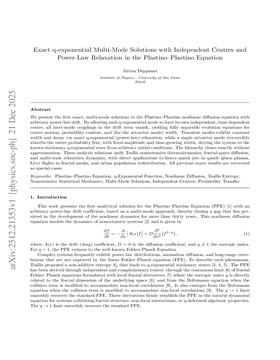
We present the first exact, multi-mode solutions to the Plastino-Plastino nonlinear diffusion equation with arbitrary power-law drift. By allowing each $q$-exponential mode to have its own independent, time-dependent centre, all inter-mode couplings in the drift term vanish, yielding fully separable evolution equations for centre motion, probability content, and (for the attractor mode) width. Transient modes exhibit constant width and decay via exact q-exponential (power-law) relaxation, while a single attractor mode irreversibly absorbs the entire probability flux, with fixed amplitude and time-growing width, driving the system to the known stationary q-exponential state from arbitrary initial conditions. The hierarchy closes exactly without approximation. These analytic solutions unify Tsallis nonextensive thermodynamics, fractal-space diffusion, and multi-scale relaxation dynamics, with direct applications to heavy-quark jets in quark-gluon plasma, Lévy flights in fractal media, and urban population redistribution. All previous exact results are recovered as special cases.
Summary
This paper tackles the Plastino-Plastino Equation (PPE), a nonlinear diffusion equation used to model nonextensive systems exhibiting power-law distributions and anomalous diffusion. The authors present the first exact, multi-mode solutions to the PPE with an arbitrary power-law drift coefficient. The key innovation lies in allowing each q-exponential mode to have its own independent, time-dependent center. This decoupling eliminates inter-mode couplings in the drift term, resulting in fully separable evolution equations for the center motion, probability content, and width (for the attractor mode). Transient modes exhibit constant width and decay via exact q-exponential relaxation, while a single attractor mode irreversibly absorbs the entire probability flux, leading to the known stationary q-exponential state. This hierarchy closes exactly without approximation. The analytical solutions presented unify Tsallis nonextensive thermodynamics, fractal-space diffusion, and multi-scale relaxation dynamics. The authors demonstrate the applicability of their solutions to various fields, including heavy-quark jets in quark-gluon plasma, Lévy flights in fractal media, and urban population redistribution. They show that previous exact results are recovered as special cases of their more general solution. The significance of this work lies in providing analytical tools to study the transient, multimodal dynamics of nonextensive systems, offering a benchmark for numerical simulations and deeper insights into multi-scale relaxation phenomena where exact solutions were previously scarce.
Key Insights
- •Novel Multi-Mode Ansatz: The core innovation is the introduction of independent, time-dependent centers for each q-exponential mode, allowing for analytical separability in the PPE.
- •Exact Separability: The multi-mode ansatz leads to fully separable ordinary differential equations for amplitudes, centers, and widths, enabling exact solutions.
- •Power-Law Relaxation: Transient modes decay via exact q-exponential (power-law) relaxation, with constant widths, providing a clear picture of how non-equilibrium states evolve.
- •Attractor Dynamics: A single attractor mode with β₀ = α + 1 (where A(x) = -kx^α) absorbs the entire probability flux, driving the system to the stationary q-exponential state, with its width growing over time.
- •Probability Transfer Mechanism: The paper introduces a probability transfer mechanism, where transient modes decay and transfer their probability to the attractor mode, ensuring total probability conservation. The decay rates are explicitly calculated.
- •Generalization of Existing Solutions: The presented solutions recover all previously known exact solutions as special cases, demonstrating the framework's generality.
- •Specific Drift Exponents: The authors explicitly derive solutions for linear (α=1), constant (α=0), and fractional (α=-0.5) drift, highlighting the versatility of their approach.
Practical Implications
- •Modeling Complex Systems: The multi-mode solutions provide a powerful tool for modeling complex systems with power-law distributions and anomalous diffusion, such as those found in physics, urban science, and finance.
- •Applications in Quark-Gluon Plasma Physics: The solutions can be used to model the dynamics of heavy-quark jets in quark-gluon plasma, offering an exact benchmark for extracting nonextensive signatures from LHC data.
- •Urban Planning and Population Dynamics: The framework allows for modeling post-disruption population redistribution across cities, aiding in urban planning and disaster response.
- •Fractal Media Analysis: The solutions can be applied to analyze transient Lévy flights in fractal media, such as granular materials and turbulent flows.
- •Future Research Directions: The paper opens up avenues for future research, including extensions to higher dimensions, inhomogeneous diffusion coefficients, coupled multi-species systems, and thermodynamic interpretations of probability transfer between modes.
Links & Resources
Authors
Cite This Paper
Deppman, A. (2025). Exact $q$-exponential Multi-Mode Solutions with Independent Centres and Power-Law Relaxation in the Plastino-Plastino Equation. arXiv preprint arXiv:2512.21353.
Airton Deppman. "Exact $q$-exponential Multi-Mode Solutions with Independent Centres and Power-Law Relaxation in the Plastino-Plastino Equation." arXiv preprint arXiv:2512.21353 (2025).