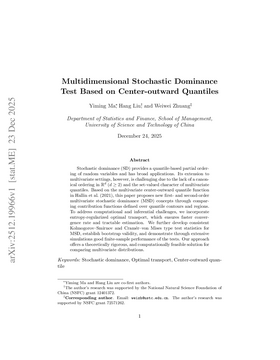
Multidimensional Stochastic Dominance Test Based on Center-outward Quantiles
Abstract
Stochastic dominance (SD) provides a quantile-based partial ordering of random variables and has broad applications. Its extension to multivariate settings, however, is challenging due to the lack of a canonical ordering in $\mathbb{R}^d$ ($d \ge 2$) and the set-valued character of multivariate quantiles. Based on the multivariate center-outward quantile function in Hallin et al. (2021), this paper proposes new first- and second-order multivariate stochastic dominance (MSD) concepts through comparing contribution functions defined over quantile contours and regions. To address computational and inferential challenges, we incorporate entropy-regularized optimal transport, which ensures faster convergence rate and tractable estimation. We further develop consistent Kolmogorov-Smirnov and Cramér- von Mises type test statistics for MSD, establish bootstrap validity, and demonstrate through extensive simulations good finite-sample performance of the tests. Our approach offers a theoretically rigorous, and computationally feasible solution for comparing multivariate distributions.
Summary
This paper addresses the challenge of extending stochastic dominance (SD) to multivariate settings. Univariate SD provides a quantile-based partial ordering of random variables, but its multivariate extension is complex due to the lack of a canonical ordering in higher dimensions and the set-valued nature of multivariate quantiles. The authors propose new first- and second-order multivariate stochastic dominance (MSD) concepts based on the center-outward quantile function introduced by Hallin et al. (2021). These concepts compare contribution functions defined over quantile contours and regions, effectively ordering multivariate distributions. To overcome computational and inferential difficulties, the authors incorporate entropy-regularized optimal transport. This approach ensures a faster convergence rate of N^{-1/2} and tractable estimation compared to classical OT estimators that suffer from slower convergence rates. They develop consistent Kolmogorov-Smirnov and Cramér-von Mises type test statistics for MSD, establish bootstrap validity using the functional delta method, and validate the tests' performance through extensive simulations. The paper presents a theoretically sound and computationally practical method for comparing multivariate distributions, addressing the limitations of existing MSD approaches that often neglect interdependencies, rely on restrictive assumptions, or exhibit poor scalability. The authors demonstrate the practical applicability of their approach through simulations and a real-data analysis comparing the S&P 500 and NASDAQ Composite indices. The simulations show the tests' ability to maintain the nominal level under the null hypothesis and their power to detect violations of dominance. The real-data analysis shows that the NASDAQ stochastically dominates the S&P 500 at the beginning of the observation period, but this dominance disappears after the COVID-19 pandemic. This highlights the method's utility in analyzing complex financial data.
Key Insights
- •Novel MSD Definitions: The paper introduces new first- and second-order MSD concepts based on comparing contribution functions over center-outward quantile contours and regions.
- •Entropy-Regularized Optimal Transport: The authors leverage entropy-regularized optimal transport to address computational challenges and improve convergence rates to N^{-1/2}, which is dimension-free.
- •Consistent Test Statistics: The paper develops consistent Kolmogorov-Smirnov and Cramér-von Mises type test statistics for MSD, offering a rigorous framework for hypothesis testing.
- •Bootstrap Validity: The authors establish bootstrap validity for the proposed tests using the directional functional delta method, providing a reliable inferential procedure.
- •Rotation Invariance: The multivariate stochastic dominance ordering is rotation-invariant due to the use of center-outward quantiles, making it robust to coordinate system changes.
- •Importance of Tuning Parameter: The choice of the tuning parameter τ_N impacts the power of the test. A moderate choice like τ_N = 2 is recommended for sample sizes up to 3000.
- •Limitations regarding contact set: When the contact set has no interior points, the test remains conservative. To address this, the critical value can be adjusted, e.g., using max{ˆc S 1−α ,η} for small η > 0, ensuring asymptotic conservativeness.
Practical Implications
- •Multivariate Distribution Comparison: The proposed method provides a practical and theoretically sound approach for comparing multivariate distributions in various fields, including finance, economics, and environmental science.
- •Portfolio Selection: Investors can use MSD to compare portfolios based on multiple factors, such as returns, risks, and liquidity, overcoming the limitations of univariate methods.
- •Policy Evaluation: Policymakers can evaluate the impact of policies on multiple correlated outcomes, such as economic, social, and ecological objectives.
- •Financial Analysis: Practitioners can apply the MSD tests to analyze financial data, such as comparing the performance of different stock market indices or mutual funds.
- •Future Research: The paper opens avenues for future research, including exploring alternative weight functions ρ, relaxing the smoothness assumptions for the entropic OT potentials, and extending the method to handle non-compact support distributions.
Links & Resources
Authors
Cite This Paper
Ma, Y., Liu, H., Zhuang, W. (2025). Multidimensional Stochastic Dominance Test Based on Center-outward Quantiles. arXiv preprint arXiv:2512.19966.
Yiming Ma, Hang Liu, and Weiwei Zhuang. "Multidimensional Stochastic Dominance Test Based on Center-outward Quantiles." arXiv preprint arXiv:2512.19966 (2025).