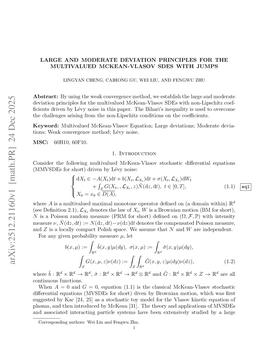
Large and Moderate deviation principles for the Multivalued McKean-Vlasov SDEs with jumps
Abstract
By using the weak convergence method, we establish the large and moderate deviation principles for the multivalued McKean-Vlasov SDEs with non-Lipschitz coefficients driven by Lévy noise in this paper. The Bihari's inequality is used to overcome the challenges arising from the non-Lipschitz conditions on the coefficients.
Summary
This paper tackles the problem of large and moderate deviations for multivalued McKean-Vlasov stochastic differential equations (MMVSDEs) with jumps. These equations are generalizations of classical stochastic differential equations that incorporate both multivalued operators and Lévy noise. The research question is to understand how the solutions of these MMVSDEs deviate from their deterministic counterparts as the noise intensity approaches zero. The authors employ the weak convergence method, a powerful tool in stochastic analysis, to establish large deviation principles (LDPs) and moderate deviation principles (MDPs). A key technical challenge arises from the non-Lipschitz coefficients in the equations, which is addressed using Bihari's inequality. The main findings are the establishment of both LDPs and MDPs for the MMVSDEs under specific conditions on the coefficients and the Lévy noise. The LDP provides an exponential estimate for the probability of rare events, while the MDP describes deviations at a rate slower than that of the LDP. The authors show that the solutions satisfy an LDP with speed ε and rate function I, and an MDP with speed ε/λ(ε)^2 and rate function I, where λ(ε) satisfies λ(ε)→ 0, ε/λ(ε)^2 → 0 as ε→ 0. These results matter to the field because they extend the existing theory of large and moderate deviations to a more general class of stochastic differential equations, which can be used to model complex phenomena in various scientific and engineering disciplines.
Key Insights
- •The paper establishes large and moderate deviation principles for a class of stochastic differential equations that includes multivalued operators and Lévy noise, extending previous results.
- •The weak convergence method is successfully applied to derive these deviation principles, even in the presence of non-Lipschitz coefficients.
- •Bihari's inequality is used to overcome the challenges arising from the non-Lipschitz conditions on the coefficients, a novel application in this context.
- •The rate functions for both the LDP and MDP are characterized in terms of the solutions to certain control problems, providing a concrete way to quantify the deviations.
- •Hypothesis 3.1 (H1-H3), Hypothesis 3.3 (H5-H7) and conditions C0, C1 and C2 establish the assumptions used to prove the main theorems.
- •The paper uses several lemmas, including Lemma 3.8 and Lemma 3.9, and propositions, including Proposition 3.6 and Proposition 3.11, to build towards the main theorems.
Practical Implications
- •The results can be applied to study the stability and robustness of stochastic systems modeled by MMVSDEs with jumps.
- •The deviation principles can be used to estimate the probability of rare events in these systems, which is crucial for risk management and reliability analysis.
- •The theoretical framework developed in this paper can be extended to analyze other types of stochastic systems with multivalued operators and jumps, such as stochastic games and optimal control problems.
- •Future research can focus on weakening the assumptions on the coefficients and the Lévy noise, as well as developing numerical methods for computing the rate functions.
Links & Resources
Authors
Cite This Paper
Cheng, L., Gu, C., Liu, W., Zhu, F. (2025). Large and Moderate deviation principles for the Multivalued McKean-Vlasov SDEs with jumps. arXiv preprint arXiv:2512.21160.
Lingyan Cheng, Caihong Gu, Wei Liu, and Fengwu Zhu. "Large and Moderate deviation principles for the Multivalued McKean-Vlasov SDEs with jumps." arXiv preprint arXiv:2512.21160 (2025).