Market-Dependent Communication in Multi-Agent Alpha Generation
Abstract
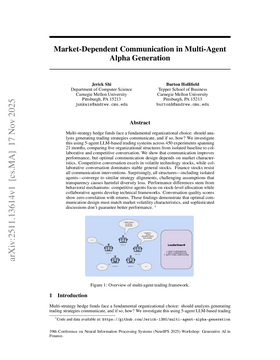
Multi-strategy hedge funds face a fundamental organizational choice: should analysts generating trading strategies communicate, and if so, how? We investigate this using 5-agent LLM-based trading systems across 450 experiments spanning 21 months, comparing five organizational structures from isolated baseline to collaborative and competitive conversation. We show that communication improves performance, but optimal communication design depends on market characteristics. Competitive conversation excels in volatile technology stocks, while collaborative conversation dominates stable general stocks. Finance stocks resist all communication interventions. Surprisingly, all structures, including isolated agents, converge to similar strategy alignments, challenging assumptions that transparency causes harmful diversity loss. Performance differences stem from behavioral mechanisms: competitive agents focus on stock-level allocation while collaborative agents develop technical frameworks. Conversation quality scores show zero correlation with returns. These findings demonstrate that optimal communication design must match market volatility characteristics, and sophisticated discussions don't guarantee better performance.
Links & Resources
Authors
Cite This Paper
Shi, J., Hollifield, B. (2025). Market-Dependent Communication in Multi-Agent Alpha Generation. arXiv preprint arXiv:2511.13614.
Jerick Shi and Burton Hollifield. "Market-Dependent Communication in Multi-Agent Alpha Generation." arXiv preprint arXiv:2511.13614 (2025).