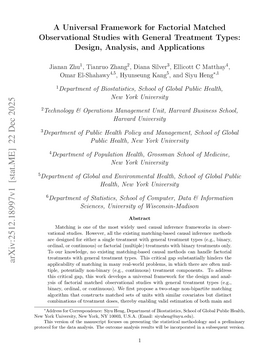
A Universal Framework for Factorial Matched Observational Studies with General Treatment Types: Design, Analysis, and Applications
Abstract
Matching is one of the most widely used causal inference frameworks in observational studies. However, all the existing matching-based causal inference methods are designed for either a single treatment with general treatment types (e.g., binary, ordinal, or continuous) or factorial (multiple) treatments with binary treatments only. To our knowledge, no existing matching-based causal methods can handle factorial treatments with general treatment types. This critical gap substantially hinders the applicability of matching in many real-world problems, in which there are often multiple, potentially non-binary (e.g., continuous) treatment components. To address this critical gap, this work develops a universal framework for the design and analysis of factorial matched observational studies with general treatment types (e.g., binary, ordinal, or continuous). We first propose a two-stage non-bipartite matching algorithm that constructs matched sets of units with similar covariates but distinct combinations of treatment doses, thereby enabling valid estimation of both main and interaction effects. We then introduce a new class of generalized factorial Neyman-type estimands that provide model-free, finite-population-valid definitions of marginal and interaction causal effects under factorial treatments with general treatment types. Randomization-based Fisher-type and Neyman-type inference procedures are developed, including unbiased estimators, asymptotically valid variance estimators, and variance adjustments incorporating covariate information for improved efficiency. Finally, we illustrate the proposed framework through a county-level application that evaluates the causal impacts of work- and non-work-trip reductions (social distancing practices) on COVID-19-related and drug-related outcomes during the COVID-19 pandemic in the United States.
Summary
This paper addresses a critical gap in causal inference methodology: the lack of matching-based methods for observational studies with factorial treatments where treatment components can be general types (binary, ordinal, or continuous). Existing methods are limited to either single treatments with general types or factorial treatments with only binary types. The authors propose a universal framework for the design and analysis of factorial matched observational studies with general treatment types. This framework allows researchers to study main and interaction effects of multiple treatments without dichotomizing or aggregating continuous treatments. The authors introduce a two-stage non-bipartite matching algorithm to construct matched sets of units with similar covariates but distinct combinations of treatment doses. This allows for valid estimation of both main and interaction effects. They also define a new class of generalized factorial Neyman-type estimands, which provide model-free, finite-population-valid definitions of marginal and interaction causal effects. Furthermore, the authors develop randomization-based Fisher-type and Neyman-type inference procedures, including unbiased estimators, asymptotically valid variance estimators, and variance adjustments to improve efficiency by incorporating covariate information. The framework is illustrated with a county-level application examining the causal impacts of work- and non-work-trip reductions on COVID-19-related and drug-related outcomes during the pandemic. This work matters to the field because it expands the applicability of matching in real-world problems where factorial treatments with general types are common, offering a more nuanced and accurate approach to causal inference.
Key Insights
- •The paper introduces a novel two-stage non-bipartite matching algorithm tailored for factorial treatments with general treatment types, preserving the original treatment scales and avoiding information loss from dichotomization or aggregation.
- •It proposes generalized factorial Neyman-type estimands, which are model-free and finite-population-valid, allowing for the estimation of both main and interaction effects in factorial observational studies with general treatment types. These are the first estimands of this kind.
- •Randomization-based Fisher-type and Neyman-type inference procedures are developed, providing unbiased estimators and asymptotically valid variance estimators for the proposed estimands.
- •Variance adjustments incorporating covariate information are introduced to improve the efficiency of the inference procedures, leading to more precise estimates of causal effects.
- •The method avoids the problematic practices of dichotomizing continuous treatments or combining them into a single composite measure, which can lead to biased or uninterpretable results.
- •The paper highlights the limitations of existing approaches, such as separate inferences, dichotomization, and aggregation, which either fail to define potential outcomes jointly or rely on strong assumptions about the relationship between treatments.
- •A key limitation is the computational complexity of the two-stage matching algorithm, which may be challenging for very large datasets. The paper also assumes no unmeasured confounding after matching, which is a standard but potentially strong assumption in observational studies.
Practical Implications
- •The framework can be applied to a wide range of real-world problems involving factorial treatments with general treatment types, such as evaluating the effects of multiple policy interventions or studying the combined effects of different risk factors on health outcomes.
- •Researchers and practitioners in fields like public health, economics, and social sciences can benefit from this framework to conduct more rigorous and nuanced causal inference in observational studies.
- •Engineers and data scientists can implement the proposed matching algorithm and inference procedures using readily available statistical software packages.
- •Future research directions include extending the framework to handle more complex treatment structures, such as time-varying treatments or network interference, and developing more efficient matching algorithms for large datasets. The authors also suggest investigating sensitivity analyses to assess the robustness of the causal inferences to potential unmeasured confounding.
Links & Resources
Authors
Cite This Paper
Zhu, J., Zhang, T., Silver, D., Matthay, E., El-Shahawy, O., Kang, H., Heng, S. (2025). A Universal Framework for Factorial Matched Observational Studies with General Treatment Types: Design, Analysis, and Applications. arXiv preprint arXiv:2512.18997.
Jianan Zhu, Tianruo Zhang, Diana Silver, Ellicott Matthay, Omar El-Shahawy, Hyunseung Kang, and Siyu Heng. "A Universal Framework for Factorial Matched Observational Studies with General Treatment Types: Design, Analysis, and Applications." arXiv preprint arXiv:2512.18997 (2025).