Drug-like antibodies with low immunogenicity in human panels designed with Latent-X2
Abstract
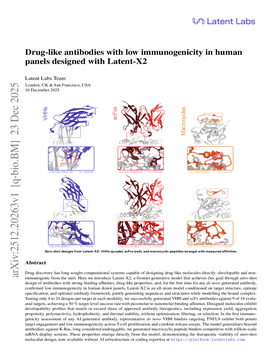
Drug discovery has long sought computational systems capable of designing drug-like molecules directly: developable and non-immunogenic from the start. Here we introduce Latent-X2, a frontier generative model that achieves this goal through zero-shot design of antibodies with strong binding affinities, drug-like properties, and, for the first time for any de novo generated antibody, confirmed low immunogenicity in human donor panels. Latent-X2 is an all-atom model conditioned on target structure, epitope specification, and optional antibody framework, jointly generating sequences and structures while modelling the bound complex. Testing only 4 to 24 designs per target in each modality, we successfully generated VHH and scFv antibodies against 9 of 18 evaluated targets, achieving a 50% target-level success rate with picomolar to nanomolar binding affinities. Designed molecules exhibit developability profiles that match or exceed those of approved antibody therapeutics, including expression yield, aggregation propensity, polyreactivity, hydrophobicity, and thermal stability, without optimization, filtering, or selection. In the first immunogenicity assessment of any AI-generated antibody, representative de novo VHH binders targeting TNFL9 exhibit both potent target engagement and low immunogenicity across T-cell proliferation and cytokine release assays. The model generalizes beyond antibodies: against K-Ras, long considered undruggable, we generated macrocyclic peptide binders competitive with trillion-scale mRNA display screens. These properties emerge directly from the model, demonstrating the therapeutic viability of zero-shot molecular design, now available without AI infrastructure or coding expertise at https://platform.latentlabs.com.
Summary
The paper introduces Latent-X2, a novel generative AI model for de novo design of therapeutic molecules, specifically antibodies and macrocyclic peptides. The central problem addressed is the need for computational systems that can directly generate drug-like molecules with desirable properties like high binding affinity, developability (e.g., high expression yield, low aggregation), and low immunogenicity, bypassing lengthy and often unsuccessful optimization processes. Latent-X2 is an all-atom model conditioned on target structure, epitope specification, and optional antibody framework, jointly generating sequences and structures while modeling the bound complex. The model was evaluated against 18 targets, achieving a 50% target-level success rate for antibody design (VHH and scFv) with picomolar to nanomolar binding affinities, with only 4-24 designs tested per modality. Crucially, the designed VHH antibodies targeting TNFL9 demonstrated low immunogenicity in human donor panels, a first for AI-generated antibodies. Additionally, the model generated macrocyclic peptide binders against K-Ras that matched or exceeded the performance of trillion-scale mRNA display screens. These findings demonstrate the potential of zero-shot molecular design for creating viable therapeutic candidates.
Key Insights
- •First demonstration of low immunogenicity for de novo AI-generated antibodies: VHH binders designed by Latent-X2 targeting TNFL9 showed no detectable immunogenic response in ex vivo T-cell proliferation and cytokine release assays using human donor panels.
- •High target-level success rate: Latent-X2 achieved a 50% target-level success rate across 18 targets for antibody design, with only 4 to 24 designs tested per target and modality.
- •Picomolar to nanomolar binding affinities: The model generated antibodies with binding affinities as strong as 26.2 pM against HDAC8.
- •Drug-like developability without optimization: 47% of the confirmed binders met or exceeded the thresholds derived from therapeutic antibodies on all four developability metrics (monomericity, hydrophobicity, thermostability, polyreactivity), and 80% met or exceeded thresholds on three of four.
- •Outperformance of trillion-scale mRNA display for macrocycles: Latent-X2 achieved hit rates of 80-90% for macrocyclic peptide binders against PHD2 and K-Ras(G12D) from only 10 designs per target, compared to 5 and 16 validated hits respectively, from libraries exceeding one trillion members in mRNA display. Against PHD2, the best Latent-X2 macrocycle achieved 1.54 nM affinity, compared to 729 nM for the best-reported RaPID hit.
- •Generalization across modalities: A single model architecture was used for VHHs, scFvs, macrocyclic peptides, and mini-binders without task-specific fine-tuning.
- •In silico filtering is essential: To select viable designs, the authors apply an *in silico* filter based on structure prediction models, with an average pass rate of approximately 1%, highlighting the need for generating a large number of designs.
Practical Implications
- •Accelerated drug discovery: Latent-X2 can significantly accelerate the drug discovery process by generating drug-like molecules with high binding affinity, developability, and low immunogenicity from the outset, reducing the need for extensive optimization.
- •Personalized therapeutics and rapid pandemic response: The efficiency gains enable individual researchers to design antibodies, making applications such as personalized therapeutics and rapid pandemic response more feasible.
- •Targeting "undruggable" targets: The model's ability to generate macrocyclic peptides that match or exceed the performance of mRNA display screens opens up new possibilities for targeting traditionally "undruggable" targets like K-Ras.
- •Reduced reliance on animal studies: The demonstration of low immunogenicity in human donor panels suggests that AI-generated molecules can now clear preclinical hurdles that previously required lengthy optimization, potentially reducing reliance on animal studies.
- •Future research directions: The authors suggest extending immunogenicity assessment across additional targets, exploring functional assays such as agonism and T-cell engagement, and understanding failure modes on remaining targets. Further work includes expanding to full IgG and other antibody formats, as well as optimizing macrocyclic peptides for cell penetration and oral bioavailability.
Links & Resources
Authors
Cite This Paper
Team, L. L., Kenlay, H., Pretorius, D., Crabbé, J., Bridgland, A., Schmon, S. M., Hilmkil, A., Vuckovic, J., Mathis, S., Matteson, T., Bartke-Croughan, R., Motmaen, A., Rombach, R., Vlachynská, M., Nelson, A. W. R., Yuan, D., Obika, A., Kohl, S. A. A. (2025). Drug-like antibodies with low immunogenicity in human panels designed with Latent-X2. arXiv preprint arXiv:2512.20263.
Latent Labs Team, Henry Kenlay, Daniella Pretorius, Jonathan Crabbé, Alex Bridgland, Sebastian M. Schmon, Agrin Hilmkil, James Vuckovic, Simon Mathis, Tomas Matteson, Rebecca Bartke-Croughan, Amir Motmaen, Robin Rombach, Mária Vlachynská, Alexander W. R. Nelson, David Yuan, Annette Obika, and Simon A. A. Kohl. "Drug-like antibodies with low immunogenicity in human panels designed with Latent-X2." arXiv preprint arXiv:2512.20263 (2025).